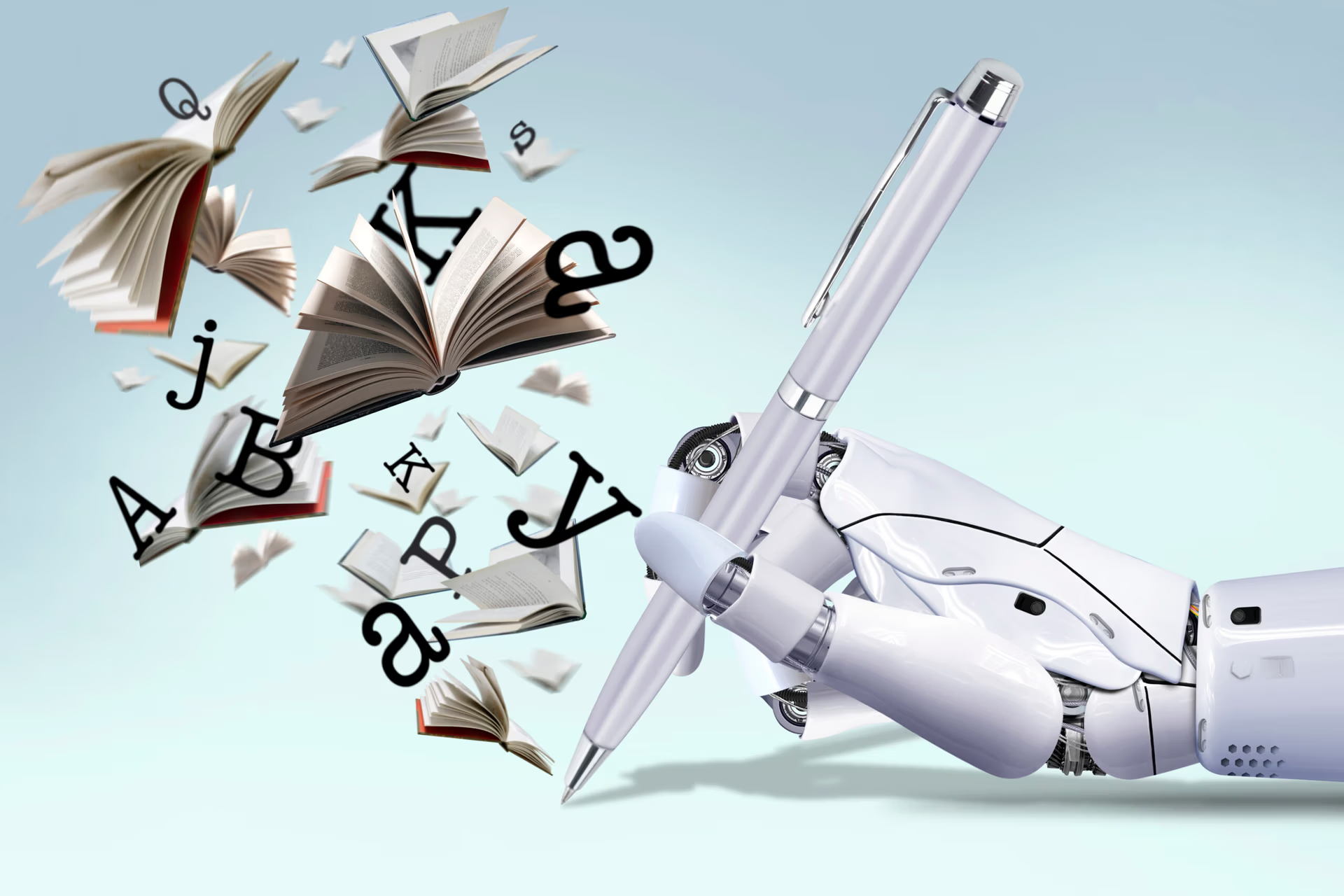
Legal translation: AI vs. human has become a major issue for lawyers, notaries, and legal departments who must choose the most reliable method to secure their documents. Between the efficiency of artificial intelligence tools and the irreplaceable expertise of professional translators, knowing when to use one or the other is essential. Legal translation relies on absolute precision: a nuance can change a clause, a term can transform the scope of a contract. Understanding the strengths and limitations of each approach helps avoid errors and ensure legal compliance.
Why legal translation cannot be treated like conventional translation
A legal text is not an ordinary text. Every word, every logical connector, and every formulation has a specific meaning. A misinterpreted clause can alter the balance of a contract, create ambiguity, or lead to litigation. While a commercial translation may tolerate nuances, a contract, notarized document, or court decision cannot.
Legal concepts vary depending on the jurisdiction. The same term can have different meanings in common law, continental law, or international law. Legal translation therefore requires a high level of expertise, knowledge of the context, and a thorough understanding of the legal systems involved. It is this complexity that makes the choice between AI and humans so crucial.
Legal translation by AI: advantages, limitations, and risks
Legal translation using AI offers undeniable advantages. It allows you to quickly produce a coherent first draft, handle large volumes, and harmonize terminology throughout a document. This speed is particularly valuable when teams need to analyze large contracts within tight deadlines.
However, general-purpose AI tools are not suited to the specificities of legal language. They can produce misinterpretations, ignore the nuances specific to each legal system, or apply incorrect terms to sensitive clauses. The risk is even greater when the translation involves precise legal concepts.
Confidentiality is another area requiring vigilance. Many automated tools use data to train their models. The CNIL regularly highlights the dangers of using uncontrolled tools to process sensitive documents. A contract or deed cannot be exposed unnecessarily. For this reason, the use of specialized AI remains essential for legal professionals.
Specialized AI legal translation tools rely on reliable terminology. Resources such as IATE demonstrate the importance of terminological consistency in international law. However, to be fully effective, AI must be trained exclusively on legal corpora.
The added value of human beings in legal translation
Human translation remains indispensable in situations where interpretation, nuance, or legal liability come into play. A qualified legal translator understands the context, interprets the intentions of the parties, and identifies the sensitive points in the document. Where AI applies a rule, a human analyzes the consequences.
Expert translators have a thorough understanding of the subtleties of legal language. They know that certain terms cannot be translated literally and adapt their work to the target jurisdiction. They can also identify inconsistencies between clauses, prevent ambiguity, and suggest wording that complies with legal practice.
In complex contracts, notarized deeds, or documents intended for submission to an authority, human expertise offers a level of security that AI alone cannot guarantee.
The hybrid solution: how Lexa combines legal AI and human expertise
The Lexa solution is based on a hybrid model that combines AI specialized in legal translation with the human expertise of Legal 230's translators. Unlike generalist tools, Lexa is trained exclusively on legal documents. It applies terminology glossaries by area of law and guarantees the essential terminological consistency required for complex projects.
Thanks to its legal AI, Lexa identifies sensitive terms, applies the appropriate terminology, and harmonizes translations even when they involve multiple languages or contributors. Professionals can then request a human proofread for high-stakes documents.
Lexa's advanced features are presented on the page dedicated to features. In particular, they enable you to manage large volumes, ensure the traceability of translations, and obtain results that comply with the requirements of legal departments.
Confidentiality remains essential. Documents are never used to train the model. They are processed securely in accordance with the commitments detailed in the confidentiality section of Lexa.
This hybrid approach combines speed, accuracy, and reliability. AI provides efficiency and standardization, while humans bring nuance and legal certainty.
When to choose AI? When to choose humans? The right scenarios
AI is ideal for complex but standardized documents, preliminary analyses, large contracts that need to be reviewed quickly, or documents where terminological consistency is paramount. It provides an instantly usable and readable version, which is useful for internal reviews or initial analyses.
However, human translation remains essential for sensitive contracts, official documents, projects involving significant responsibilities, or documents subject to specific jurisdiction. In these cases, human expertise guarantees accurate interpretation and legally compliant wording.
The combination of the two secures the entire process. AI prepares the ground and speeds up the work, while humans validate critical elements. This complementary approach is the most effective method for meeting current legal needs.
Conclusion: AI and human translation are not opposed to each other; they complement each other.
AI vs. human legal translation should not be seen as a conflict, but rather as complementary. AI speeds up processes, improves consistency, and reduces costs. Humans bring nuance, interpretation, and legal responsibility. Together, they enable reliable, fast, and secure translation.
Thanks to its specialized approach, Lexa is fully in step with this evolution. It puts the power of AI at the service of legal professionals while ensuring quality and legal compliance through the intervention of human experts when necessary.
FAQ – AI vs. Human Legal Translation
Can AI legal translation replace human translation?
No. AI is very effective at producing consistent drafts, but humans remain indispensable for validating nuances, interpreting clauses, and ensuring legal compliance.
What types of documents can be translated by AI?
Large documents, preliminary analyses, and standard contracts can be translated by AI. Notarized documents, sensitive clauses, or complex contracts require human expertise.
Does Lexa guarantee the reliability of AI-powered legal translation?
Yes. Lexa relies on specialized legal AI and offers expert review by Legal 230 to enhance the quality of sensitive documents.
What are the risks of using general-purpose AI to translate a contract?
Risks include misinterpretations, terminology errors, legal inconsistencies, and confidentiality issues.
How do I know whether to choose AI or a human translator?
It all depends on the level of risk. For high-stakes documents, opt for human intervention. For large or standardized documents, specialized AI such as Lexa is ideal.